Prostate Enlargement Treatment in Chembur, Mumbai
Are you waking up several times at night to urinate, experiencing a weak urine stream or feeling that your bladder is not emptying completely? These symptoms may be associated with an enlarged prostate, also known as Benign Prostatic Hyperplasia (BPH).
Prostate enlargement is a common, non-cancerous condition that becomes more frequent with age. Dr. Shyam Mohan, Consultant Urologist, Uro-Oncologist and Robotic Surgeon in Chembur, Mumbai (MBBS, MS, MCh Urology), provides clinical evaluation and comprehensive management—from lifestyle changes and targeted medications to advanced TURP and HoLEP laser prostate surgery.
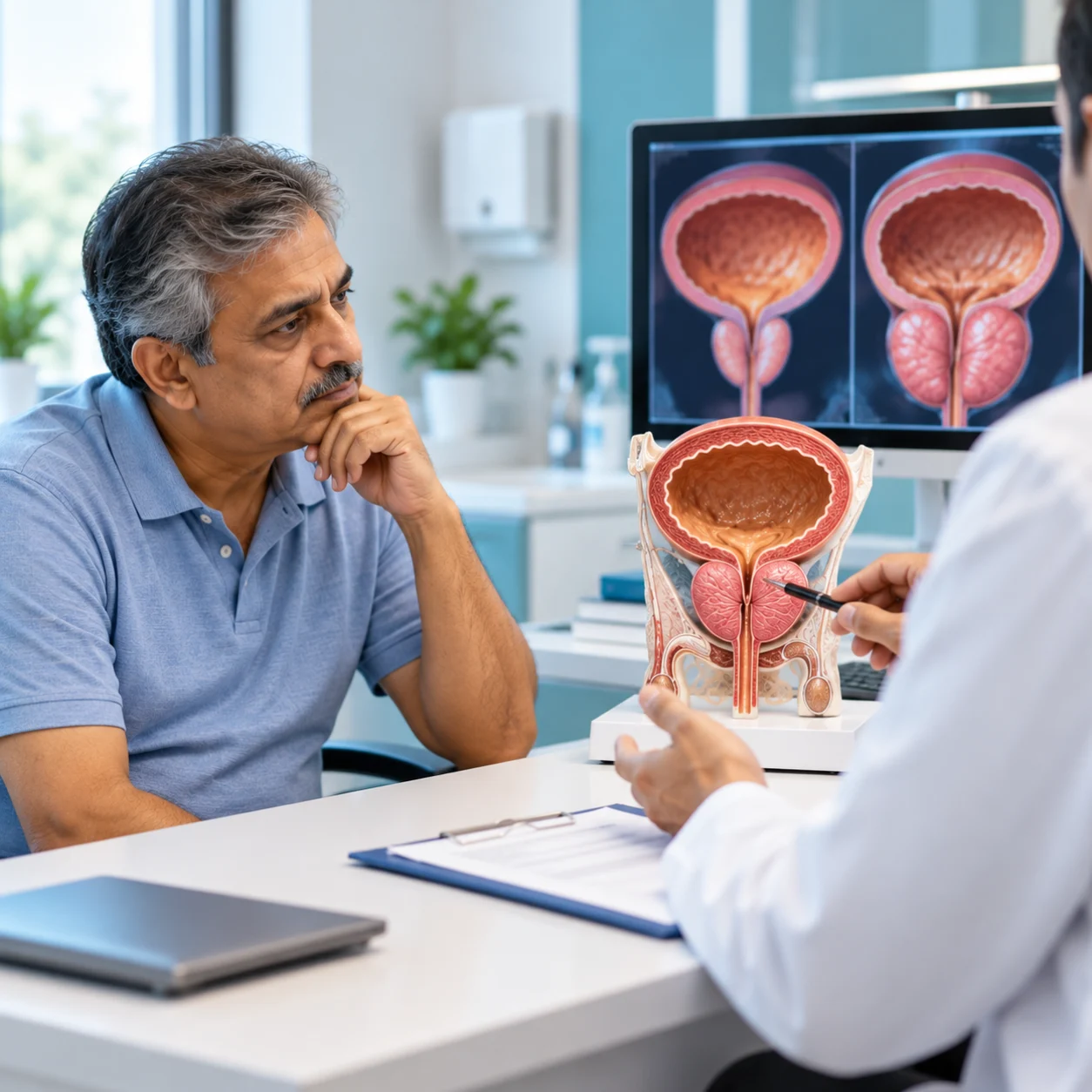
What Is Prostate Enlargement (BPH)?
The prostate is a small gland located below the urinary bladder in men. It surrounds part of the urethra, the tube that carries urine out of the body. As men age, the prostate may gradually increase in size. This condition is called Benign Prostatic Hyperplasia (BPH).
When the enlarged prostate presses against the urethra, it may restrict urine flow and make it more difficult to empty the bladder. However, not every enlarged prostate causes urinary problems. Some men with a larger prostate have few symptoms, while others with a smaller enlargement experience considerable urinary difficulty.
BPH is not cancer and does not itself mean that prostate cancer is present. However, the two conditions can coexist, and urinary symptoms may have other causes.
Common Symptoms of an Enlarged Prostate
Prostate enlargement symptoms usually develop gradually and become more noticeable over time:
- Frequent urination: Needing to pass urine more often than usual.
- Nocturia: Waking up repeatedly at night to urinate.
- Weak urine stream: Reduced force or slow flow of urine.
- Difficulty starting: Taking time/straining before urine begins to flow.
- Incomplete emptying: Sensation that urine remains in the bladder.
- Intermittent stream: Urine starts and stops during urination.
- Urinary urgency: A sudden, difficult-to-control urge.
- Post-urination dribbling: Leakage of urine after finishing.
When Should You See a Urologist?
Consult a urologist if you experience persistent symptoms affecting sleep or daily activities. Seek urgent medical assessment for:
- Sudden inability to pass urine (acute urinary retention)
- Severe lower abdominal pain with difficulty urinating
- Fever or chills associated with urinary symptoms
- Visible blood in the urine (hematuria)
- Reduced urine output with significant discomfort
What Causes Prostate Enlargement?
The exact biological causes of BPH are not completely understood. Age-related hormonal changes and growth factors contribute to prostate growth. Factors associated with increased likelihood include:
Increasing Age & Hormonal Shifts
BPH becomes increasingly common after age 50 as testosterone and dihydrotestosterone (DHT) levels shift.
Genetics & Family History
Having a father or brother with an enlarged prostate increases your personal likelihood of developing BPH.
Metabolic Conditions & Obesity
Excess body weight and metabolic syndrome are associated with faster prostate growth.
Lifestyle Factors
Physical inactivity may aggravate urinary symptoms, though drinking water or sexual activity does not cause BPH.
How Is Prostate Enlargement Diagnosed?
1. Medical History and IPSS Score
Assessing frequency, nocturia, weak stream, urgency, and calculating the International Prostate Symptom Score (IPSS).
2. Physical & Digital Rectal Examination (DRE)
A quick, gentle clinical examination to assess the approximate size, consistency, symmetry and feel of the prostate gland.
3. Urine Examination & PSA Blood Test
Urine testing rules out infection or micro-hematuria. The Prostate-Specific Antigen (PSA) blood test checks for elevation, which can occur in BPH, inflammation or malignancy.
4. Ultrasound KUB & Post-Void Residual (PVR)
Measures exact prostate volume in grams and determines if the bladder empties adequately or leaves residual urine.
5. Uroflowmetry Test
Measures the speed and pattern of urine flow to objectively quantify the extent of obstruction at the bladder outlet.
Prostate Enlargement Treatment Options in Chembur, Mumbai
Not every man with BPH requires an operation. Treatment depends on symptom severity, prostate size, and complications:
1. Lifestyle Changes and Regular Monitoring
For mild symptoms: reducing fluids before bedtime, limiting caffeine and alcohol, maintaining regular physical activity, avoiding delay in voiding, and managing constipation.
2. Medicines for Enlarged Prostate
Commonly prescribed pharmacological options include:
- Alpha-blockers: (Tamsulosin, Silodosin, Alfuzosin) relax smooth muscle at the bladder neck and prostate to quickly improve urinary flow.
- 5-alpha-reductase inhibitors: (Finasteride, Dutasteride) gradually shrink prostate gland volume over several months to reduce long-term risk of retention.
3. TURP Surgery for Prostate Enlargement
Transurethral Resection of the Prostate (TURP) is an established endoscopic procedure to core out obstructing prostate tissue through the natural urinary passage without skin cuts.
4. HoLEP Laser Prostate Surgery
Holmium Laser Enucleation of the Prostate (HoLEP) is an advanced endoscopic laser technique that enucleates obstructing lobes cleanly with minimal blood loss, suitable across a wide range of prostate sizes (including massive glands >100g).
5. Minimally Invasive & Open/Robotic Simple Prostatectomy
For massive prostate enlargement or complex bladder stone co-pathology where enucleation or simple robotic prostatectomy provides definitive relief.
TURP vs HoLEP — Which Is Better for Enlarged Prostate?
| Factor | TURP | HoLEP |
|---|---|---|
| Surgical approach | Endoscopic resection | Endoscopic laser enucleation |
| External incision | Usually none | Usually none |
| Prostate size suitability | Commonly selected for small-to-medium glands | Suitable across a broad range of sizes (small to >100g) |
| Bleeding risk | Possible / moderate | Often less bleeding due to laser coagulation |
| Catheter duration | Usually temporary (2–3 days) | Usually temporary (1–2 days) |
| Recovery | Rapid return to light activities | Rapid return to light activities |
| Sexual side effects | Retrograde ejaculation possible | Retrograde ejaculation possible |
When Is Surgery Needed for Prostate Enlargement?
A urologist may recommend TURP or HoLEP when:
- Urinary symptoms remain troublesome despite appropriate medical treatment
- Repeated episodes of acute urinary retention occur
- Significant post-void residual urine impairs bladder function
- Recurrent urinary tract infections occur as a result of stagnation
- Bladder stones form due to incomplete emptying
- Kidney function is compromised by backpressure obstruction (hydronephrosis)
- Recurrent visible bleeding (hematuria) is attributed to BPH
Recovery After Prostate Enlargement Surgery
After TURP or HoLEP, a temporary catheter is placed for 24–72 hours to allow the prostatic bed to heal. Light daily activities can be resumed gradually within a few days, while heavy lifting and strenuous activity should be avoided for 2–4 weeks.
Enlarged Prostate vs Prostate Cancer — What Is the Difference?
| Feature | Prostate Enlargement (BPH) | Prostate Cancer |
|---|---|---|
| Nature | Non-cancerous (benign) prostate growth | Malignant (cancerous) growth |
| Common presentation | Noticeable urinary flow & frequency symptoms | Often no symptoms in early stages |
| PSA level | May be elevated due to gland volume | May be elevated, but not always |
| Diagnosis | Clinical assessment, ultrasound, uroflowmetry | Risk assessment, mpMRI and biopsy |
| Treatment | Monitoring, medicines, TURP or HoLEP | Active surveillance, robotic surgery, radiation |
Prostate Enlargement Consultation in Chembur, Mumbai
Men experiencing frequent nighttime urination, weak urinary flow, difficulty starting urination or incomplete bladder emptying can consult Dr. Shyam Mohan at Synergy Health Clinic, Chembur.
During your consultation, bring:
- Previous Ultrasound KUB and Prostate reports
- PSA blood test results (if available)
- Urine examination reports
- Current list of medications (especially blood thinners)

Dr. Shyam Mohan
Consultant Urologist, Uro-Oncologist & Robotic Surgeon in Chembur, Mumbai. Experienced in medical management of BPH, diagnostic uroflowmetry, bipolar TURP, and advanced HoLEP laser surgery for enlarged prostate.