Kidney Cancer Treatment in Chembur, Mumbai
A kidney tumour detected during an ultrasound or CT scan can raise concerns about kidney cancer. However, not every kidney tumour is cancerous. Some kidney masses are benign, while others require further investigation and treatment.
Dr. Shyam Mohan, Consultant Urologist, Uro-Oncologist and Robotic Surgeon in Chembur, Mumbai, provides evaluation and surgical management of kidney tumours and urological cancers.
Kidney cancer treatment depends on the tumour's size, location, stage, imaging findings, kidney function and the patient's overall health. Depending on the diagnosis, treatment options may include active surveillance, partial nephrectomy, radical nephrectomy, robotic-assisted kidney surgery, ablation or systemic cancer therapies.
A uro-oncology consultation helps patients understand their diagnosis and whether monitoring, kidney-preserving surgery or another treatment approach may be appropriate.
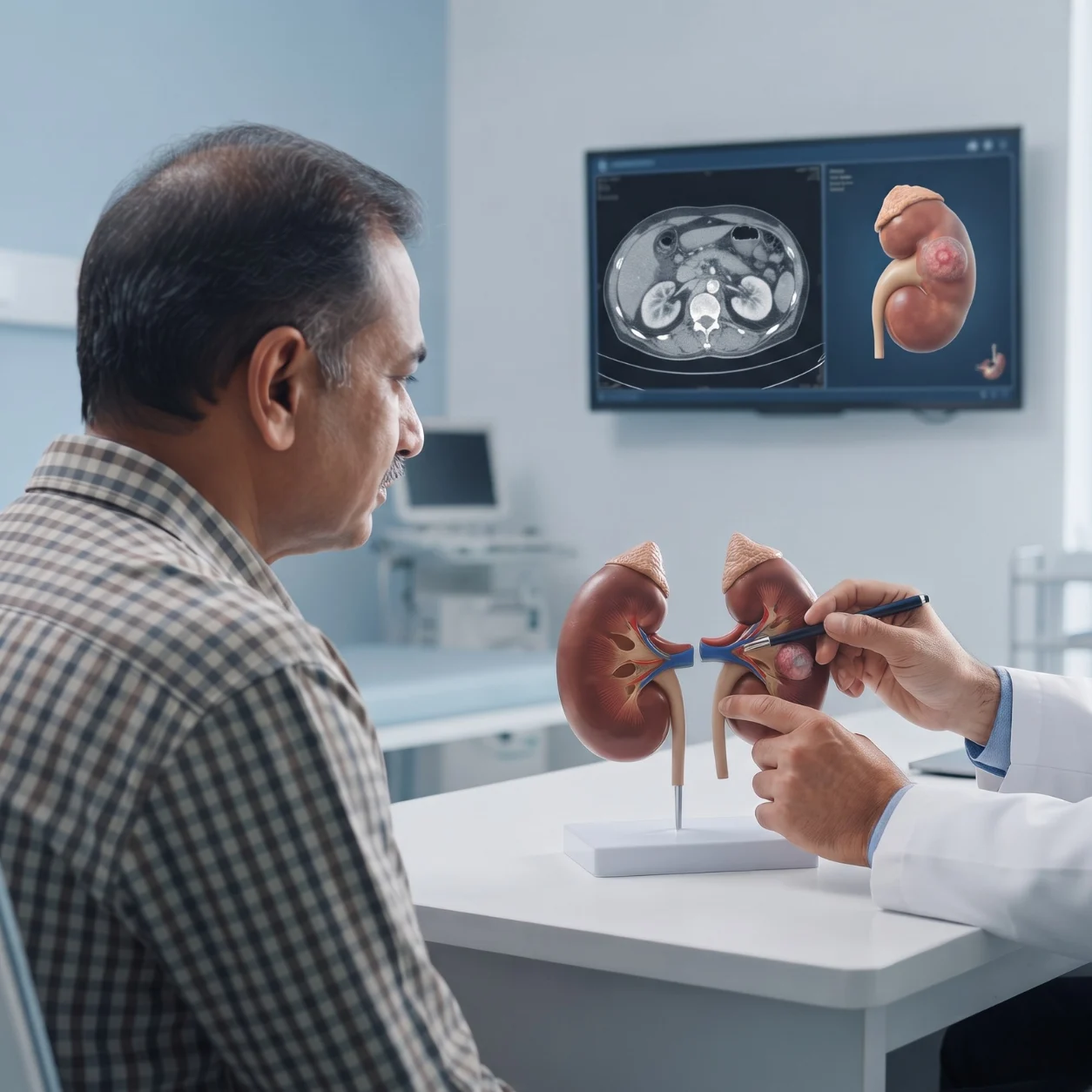
What Is Kidney Cancer?
Kidney cancer develops when abnormal cells within the kidney grow uncontrollably and form a malignant tumour.
The kidneys are two bean-shaped organs located towards the back of the abdomen. They filter waste products from the blood, maintain fluid and electrolyte balance, and produce hormones involved in blood pressure regulation and red blood cell production.
The most common type of kidney cancer in adults is Renal Cell Carcinoma (RCC).
Kidney cancer may remain confined to the kidney or extend into surrounding tissues, blood vessels, lymph nodes or distant organs.
Some kidney cancers grow slowly, while others behave more aggressively. The diagnosis, stage and tumour characteristics determine the appropriate management approach.

Types of Kidney Cancer
The main types include:
Clear Cell Renal Cell Carcinoma
The most common subtype of renal cell carcinoma. Its treatment depends on the cancer's stage and risk characteristics.
Papillary Renal Cell Carcinoma
A subtype that develops from kidney tubular cells and may have different biological characteristics from clear cell RCC.
Chromophobe Renal Cell Carcinoma
A less common subtype of kidney cancer that often has different patterns of behaviour and prognosis.
Other Rare Kidney Tumours
Less common renal cancers include collecting duct carcinoma and other uncommon pathological subtypes.
What Are the Early Signs and Symptoms of Kidney Cancer?
Early kidney cancer often causes no noticeable symptoms.
Many kidney tumours are discovered incidentally during ultrasound, CT or MRI scans performed for unrelated medical concerns.
When symptoms develop, they may include:
1. Blood in the Urine
Blood in the urine, also called hematuria, may appear pink, red or brown.
It can occur intermittently and may not always cause pain.
Blood in urine can also result from kidney stones, urinary infections and other medical conditions. It should be evaluated rather than automatically attributed to cancer.
2. Persistent Pain in the Side or Back
A tumour may occasionally cause persistent discomfort in the flank, particularly if it becomes large or affects nearby structures.
However, back pain is common and does not necessarily indicate kidney cancer.
3. An Abdominal or Flank Mass
A large kidney tumour may sometimes be associated with a noticeable mass in the abdomen or flank.
Most small kidney cancers cannot be felt during physical examination.
4. Unexplained Weight Loss
Unintentional weight loss may occur in some patients, particularly with more advanced disease.
5. Fatigue or Reduced Appetite
Some patients develop tiredness, appetite changes or other general symptoms.
Symptoms of Advanced Kidney Cancer
Advanced disease may be associated with:
- Persistent bone or back pain
- Unexplained weight loss
- Reduced appetite
- Anaemia or fatigue
- Persistent cough or breathing difficulties
- Swelling of the legs in certain circumstances
These symptoms may have many causes and do not independently confirm kidney cancer.
What Causes Kidney Cancer?
Kidney cancer develops when genetic changes affect how kidney cells grow and divide.
The exact cause is not always identifiable, but certain factors are associated with increased risk.
Smoking and Tobacco Exposure
Smoking is an established risk factor for renal cell carcinoma.
Obesity
Excess body weight is associated with a higher risk of developing kidney cancer.
High Blood Pressure
Hypertension is linked to increased RCC risk, although the relationship involves several factors.
Family History and Inherited Conditions
A family history of kidney cancer may increase risk. Certain inherited conditions, including von Hippel–Lindau syndrome and hereditary leiomyomatosis and renal cell cancer syndrome, are associated with specific kidney tumours.
Chronic Kidney Disease
Some people with advanced kidney disease, particularly those receiving long-term dialysis and developing acquired cystic kidney disease, have an increased risk.
Increasing Age
Kidney cancer becomes more common with increasing age, although it may occur in younger individuals.
Having risk factors does not necessarily mean kidney cancer will develop.
How Is Kidney Cancer Diagnosed?
Kidney cancer assessment involves imaging, evaluation of kidney function and, when appropriate, tissue sampling.
Dr. Shyam Mohan may recommend investigations based on the tumour's appearance, clinical history and other findings.
1. Ultrasound of the Kidneys
An ultrasound may identify a kidney mass or cyst during evaluation of abdominal pain, urinary problems or another medical condition.
However, ultrasound alone may not reliably determine whether a suspicious solid renal mass is malignant.
2. Contrast-Enhanced CT Scan
A multiphasic contrast-enhanced CT scan is commonly used to assess suspected renal tumours.
It helps evaluate:
- Tumour size and location
- Enhancement characteristics
- Relationship to surrounding kidney tissue
- Involvement of nearby blood vessels
- Possible extension beyond the kidney
CT findings also help determine whether partial nephrectomy or another treatment approach may be technically feasible.
3. MRI Scan
MRI may be recommended when CT findings are unclear or when additional assessment of blood vessels or tumour anatomy is needed.
It may also be considered when iodinated contrast is unsuitable, depending on kidney function and other clinical factors.
4. Blood and Urine Tests
Blood investigations may assess kidney function, haemoglobin and other relevant parameters.
Urine examination may help identify blood or other urinary abnormalities.
5. Kidney Tumour Biopsy
A renal mass biopsy involves obtaining tissue from a suspicious lesion using a needle guided by imaging.
Biopsy may be recommended when the result would influence management, such as before certain ablation procedures or systemic treatment.
Not every patient undergoing surgery for a strongly suspicious kidney tumour requires a preoperative biopsy.
6. Staging Investigations
Additional scans may be recommended to check whether kidney cancer has extended beyond the kidney.
Chest imaging is commonly used in staging.
Other investigations depend on symptoms, cancer characteristics and the clinical assessment.
Kidney Cancer Stages – Understanding Stage 1 to Stage 4
Kidney cancer is staged according to tumour size, local extension and whether cancer has spread to lymph nodes or distant organs.
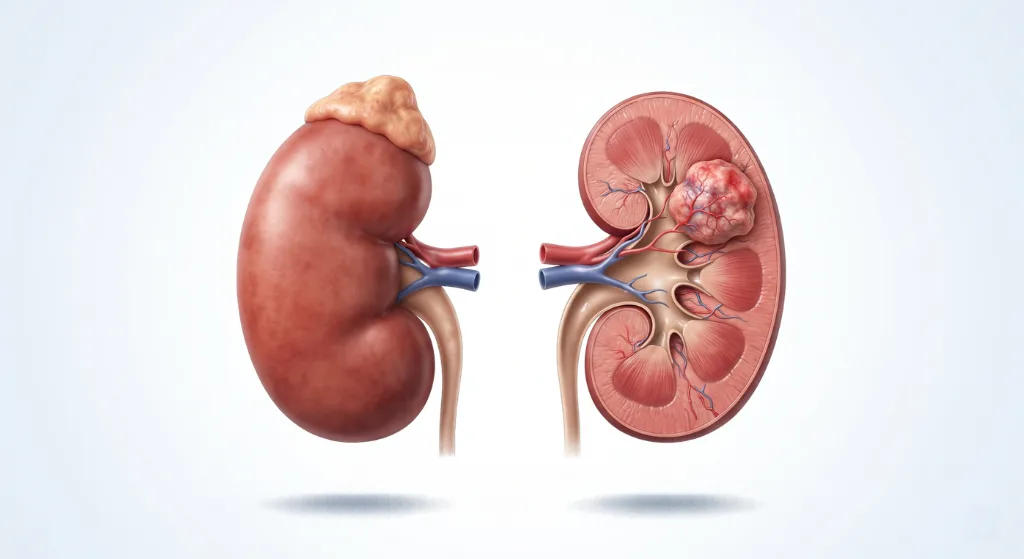
| Stage | General description |
|---|---|
| Stage I | Tumour is 7cm or smaller and confined to the kidney |
| Stage II | Tumour is larger than 7cm but remains confined to the kidney |
| Stage III | Cancer involves certain major veins, surrounding tissue within Gerota's fascia or regional lymph nodes |
| Stage IV | Cancer extends beyond Gerota's fascia, directly invades the same-side adrenal gland, or has spread to distant organs |
This is a simplified explanation. Actual staging follows the TNM classification, including tumour extent, lymph node involvement and metastasis.
The stage helps determine whether local surgery, systemic treatment or a combination of approaches may be appropriate.
Kidney Cancer Treatment Options in Chembur, Mumbai
Kidney cancer treatment depends on the tumour's size, location, stage, kidney function and individual health.
Not every kidney tumour requires immediate surgery, and not every kidney cancer requires complete kidney removal.
1. Active Surveillance for Selected Small Kidney Tumours
Active surveillance may be considered for certain small renal masses, particularly in older or medically vulnerable patients where the risks of treatment may outweigh the expected benefits.
This approach involves scheduled imaging and clinical review to assess changes in tumour size or behaviour.
Active surveillance is not the same as ignoring a tumour.
If significant growth or other concerning findings develop, active treatment may be reconsidered.
2. Partial Nephrectomy – Kidney-Preserving Cancer Surgery
Partial nephrectomy is a procedure in which the surgeon removes the kidney tumour along with an appropriate margin of surrounding tissue while preserving the remaining healthy kidney.
It is commonly preferred for suitable localised T1 kidney tumours when technically feasible.
When May Partial Nephrectomy Be Recommended?
Partial nephrectomy may be considered for:
- Selected small or localised kidney cancers
- Tumours that can be removed while preserving adequate kidney tissue
- Patients with reduced kidney function
- Patients with a solitary functioning kidney
- Certain patients with tumours affecting both kidneys
The feasibility of partial nephrectomy depends on the tumour's size, depth, location and relationship to blood vessels and the urine-collecting system.
Potential benefits include preserving functioning kidney tissue and reducing the risk of kidney function loss compared with removing the entire kidney.
However, partial nephrectomy may involve risks such as bleeding, urine leakage, injury to surrounding structures and the possibility of additional treatment.
3. Radical Nephrectomy – Complete Kidney Removal
Radical nephrectomy involves removal of the affected kidney, generally including the surrounding fatty tissue as appropriate.
It may be recommended when the tumour cannot be removed safely through partial nephrectomy or when complete kidney removal is more appropriate for cancer management.
The adrenal gland and nearby lymph nodes are not routinely removed in every case. Their management depends on the imaging findings and suspected disease involvement.
Radical nephrectomy may be performed through an open, laparoscopic or robotic-assisted approach.
Before surgery, the urologist assesses the function of the opposite kidney and the patient's risk of postoperative kidney impairment.
4. Robotic Kidney Cancer Surgery
Robotic-assisted kidney surgery is a minimally invasive approach used for selected patients requiring partial or radical nephrectomy.
During the procedure, the surgeon controls robotic instruments through small incisions while viewing the surgical area using a magnified camera system.
The robotic system does not operate independently.
Potential Benefits of Robotic Surgery
In appropriately selected cases, robotic surgery may offer:
- Smaller abdominal incisions
- Magnified surgical visualisation
- Controlled instrument movement
- Reduced blood loss in some circumstances
- Shorter hospital stay in selected patients
- An approach that may facilitate complex kidney-preserving surgery
However, robotic kidney surgery does not guarantee better cancer control, complete preservation of kidney function or freedom from complications.
The appropriate surgical technique depends on the tumour, the patient's health, available resources and the surgical team's expertise.
5. Laparoscopic Kidney Cancer Surgery
Laparoscopic surgery uses a camera and long surgical instruments inserted through small abdominal incisions.
Laparoscopic radical nephrectomy is an established approach for appropriately selected kidney cancers.
Laparoscopic partial nephrectomy may also be considered depending on tumour complexity and surgical expertise.
Not every tumour can be safely treated through a minimally invasive approach.
6. Thermal Ablation for Selected Kidney Tumours
Thermal ablation destroys tumour tissue using heat or cold rather than removing it surgically.
Methods include:
Radiofrequency energy is used to heat and destroy tumour tissue.
Very low temperatures are used to freeze and destroy selected tumour tissue.
Ablation may be considered for selected small kidney masses, particularly when surgery carries increased risk.
It may have a higher likelihood of local retreatment than surgery in some circumstances.
Renal mass biopsy is generally recommended before ablation.
7. Treatment for Advanced or Metastatic Kidney Cancer
When kidney cancer spreads beyond the kidney, systemic treatment may play an important role.
Depending on the histological subtype, disease characteristics and patient suitability, options may include:
- Immune checkpoint inhibitor combinations
- Immunotherapy combined with targeted treatment
- Tyrosine kinase inhibitors
- Other targeted medicines for selected cancer subtypes
- Radiation therapy for symptom control
- Local treatment of selected metastatic deposits
- Supportive and palliative care
In selected patients with higher-risk clear cell renal cell carcinoma following nephrectomy, adjuvant immunotherapy may also be considered after discussion of potential benefits and risks.
Not all advanced kidney cancers respond to the same medicines.
Management generally involves a multidisciplinary team, including uro-oncologists, medical oncologists, radiologists and other specialists.
Partial Nephrectomy vs Radical Nephrectomy – Which Is Better?
Both procedures are established treatments for localised kidney cancer.
| Factor | Partial Nephrectomy | Radical Nephrectomy |
|---|---|---|
| Kidney tissue removed | Tumour and part of the kidney | Entire affected kidney |
| Main objective | Remove cancer while preserving kidney function | Remove the affected kidney and tumour |
| Common indication | Suitable localised tumours | Tumours unsuitable for safe partial removal |
| Kidney preservation | Yes | No, on the affected side |
| Surgical complexity | Can be technically complex | Varies by tumour size and anatomy |
| Surgical approach | Open, laparoscopic or robotic | Open, laparoscopic or robotic |
| Recovery | Depends on patient and procedure | Depends on patient and procedure |
Partial nephrectomy is preferred for appropriate T1 renal cell carcinomas when technically feasible.
However, radical nephrectomy may be the safer or more suitable option for some complex or advanced tumours.
The final decision is based on cancer control, surgical safety and long-term kidney function.
Can Kidney Cancer Be Treated Without Removing the Entire Kidney?
Yes. Many patients with suitable localised kidney tumours may be candidates for partial nephrectomy.
This surgery removes the tumour while preserving healthy kidney tissue.
Some selected small renal masses may be managed with active surveillance or ablation instead of immediate surgery.
However, complete kidney removal may be necessary for tumours that cannot be safely treated using kidney-preserving methods.
Is Robotic Kidney Cancer Surgery Safe?
Robotic-assisted kidney surgery is an established approach for selected patients, but all surgical procedures involve potential risks.
Possible complications include:
- Bleeding
- Infection
- Injury to nearby organs
- Urine leakage after partial nephrectomy
- Blood vessel injury
- Anaesthesia-related complications
- Reduced kidney function
- Need for conversion to another surgical approach
- Residual or recurrent disease
The risks depend on tumour size, anatomical complexity, general health and the planned operation.
A urologist should explain the expected benefits, alternatives and relevant risks before treatment.
Recovery After Kidney Cancer Surgery
Recovery varies according to whether the patient undergoes partial nephrectomy, radical nephrectomy or another treatment.
Immediately After Surgery
Patients are monitored for pain, bleeding, urine output, kidney function and other postoperative concerns.
Early mobilisation, appropriate pain management and prevention of complications form part of postoperative care.
Hospital Stay
The duration of admission depends on the type of surgery, the patient's medical condition and the postoperative recovery.
Some patients undergoing uncomplicated minimally invasive procedures may leave the hospital sooner than those requiring more complex surgery.
Returning to Normal Activities
Light daily activities may be resumed gradually according to medical advice.
Heavy lifting and strenuous exercise may need to be restricted until the surgical team confirms that recovery is progressing appropriately.
Long-Term Kidney Function
After partial or radical nephrectomy, kidney function may require ongoing monitoring.
Patients with one remaining kidney can often live active lives, provided that kidney function is adequate.
Blood pressure control, appropriate hydration and management of chronic medical conditions are important.
Follow-Up After Kidney Cancer Surgery
Follow-up may include:
- Imaging to detect possible recurrence
- Blood tests to assess kidney function
- Blood pressure monitoring
- Assessment of treatment-related complications
- Review of general health
- Additional treatment evaluation when indicated
The follow-up schedule depends on cancer stage, grade, histology, treatment and individual risk.
Can Kidney Cancer Be Cured?
Many patients with localised kidney cancer can be treated with curative intent, often through surgery.
However, the likelihood of long-term cancer control depends on tumour stage, grade, histological subtype and other patient-specific factors.
Some kidney cancers may recur after surgery, which is why follow-up is important.
For metastatic kidney cancer, systemic treatments may help control disease and improve outcomes in eligible patients, but complete cure is uncommon.
No treatment can guarantee that cancer will never return.
Can Kidney Cancer Be Prevented?
Not all kidney cancers are preventable, but certain lifestyle measures may help reduce risk.
These include:
- Avoiding smoking and tobacco use
- Maintaining a healthy body weight
- Managing high blood pressure
- Staying physically active
- Following appropriate occupational safety precautions
- Seeking medical guidance when there is a strong family history of kidney cancer
Routine kidney cancer screening is not recommended for every person without symptoms.
Patients with certain inherited cancer syndromes may require a dedicated surveillance programme.
About Dr. Shyam Mohan – Kidney Cancer Specialist in Chembur, Mumbai
Dr. Shyam Mohan is a Consultant Urologist, Uro-Oncologist and Robotic Surgeon.
Qualifications:
- MBBS
- MS (General Surgery)
- MCh (Urology)
- Fellowship in Advanced Robotic Uro-Oncology
His clinical practice includes urology, uro-oncology, endourological procedures, laparoscopic urological surgery and robotic surgery.
His listed uro-oncology services include partial nephrectomy and radical nephrectomy using suitable minimally invasive approaches.
For patients with suspected kidney cancer, consultation involves reviewing imaging findings, kidney function, medical history and the possible need for surgical or multidisciplinary treatment.
Kidney Cancer Consultation in Chembur, Mumbai
Patients with a suspicious kidney mass, renal tumour detected on imaging or a confirmed renal cell carcinoma diagnosis may require evaluation by a uro-oncologist.
Dr. Shyam Mohan provides urology consultations at Synergy Health Clinic, Chembur, Mumbai.
During the consultation, patients may discuss:
- Whether a kidney mass appears suspicious
- Whether additional imaging or biopsy is required
- Whether partial nephrectomy may be feasible
- Whether radical nephrectomy is necessary
- The role of robotic or laparoscopic surgery
- Whether monitoring or ablation is appropriate
- Treatment options for advanced disease
Bring the following records, if available:
- Ultrasound KUB reports
- Contrast-enhanced CT or MRI reports and images
- Kidney function blood tests
- Previous biopsy or histopathology reports
- Previous cancer treatment records
- Current medications and medical history
A specialist evaluation helps determine the appropriate next steps according to the patient's clinical condition.
